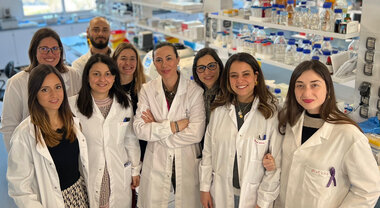
The main players in this work are the Cnr of Lecce, the Oncology Institute of Bari, the University of Salento, and international teams. A very important step forward in the fight against pancreatic cancer, one of the so-called big killers among carcinomas that affect men, women, young and old alike. And this very important innovation in the medical-scientific field also has an entirely Apulian origin. A new platform has been developed to replicate the cellular metabolic ecosystem that supports the development of tumors, particularly pancreatic cancer. This platform will make it possible to identify the most effective drug treatments to counter the onset and development of such diseases. The big killer Today is World Cancer Day, and research is making enormous efforts to contain the disease. In Italy, diagnoses of pancreatic carcinoma, defined as one of oncology's "big killers," are on the rise. In five years, new cases have increased from 12,500 in 2015 to 14,300 in 2020, mostly men between 65 and 69 and women between 75 and 79. The case of Gianluca Vialli, who died at 58, shook not only sports fans. A battle lost after many months of treatments that unfortunately were not enough to save his life. In this sense, the researchers' discovery becomes very important. Let's try to simplify, as the subject is very technical. The image can be that of a room full of people where the echo of voices makes it difficult to understand what is being said. Each cell does and says something different, just like in a community of people. One of the challenges of research is to be able to measure what individual cells are saying to each other instead of using investigative methods that measure average behavior. This platform will then allow for tailored and targeted drug therapies. A microenvironment similar to the natural one for the development of tumor cells has been created, with nanofibrous membranes containing optical sensors that simulate the structure of the extracellular matrix, the part of tissues where there are no cells. "The choice of the study model, pancreatic cancer, should be considered strategic because this disease is among the big killer tumors and is particularly resistant to drug treatments," specifies Amalia Azzariti of the Bari Cancer Institute. This study, published in the journal ACS Nano, paves the way for non-invasive, inexpensive, real-time analysis of the metabolism of individual cells. The new platform will allow the identification of new drug combinations that could represent a breakthrough in the treatment of pancreatic cancer. "We reconstructed the contribution made by each individual cell," says Daniele De Martino of the Biofisika/Ikerbasque Institute. "It was thus possible to observe that the lactic acid secreted by donor cells acts both as a signaling molecule in cellular communication and as a substrate for the acceptors." "Cancer research in recent years has made great strides," concludes Giuseppe Gigli of the Institute of Nanotechnology of the Cnr of Lecce and the Tecnomed Puglia Precision Medicine Technopole, "thanks to the use of sophisticated DNA manipulation techniques and advanced nanomaterials. We can definitely say that the path to winning the challenge has begun."
There is a lot of Apulia in this work, which features researchers from the Institute of Nanotechnology of the National Research Council of Lecce (Cnr-Nanotec) in collaboration with the Biofisika Institute (Spain), the Ikerbasque Foundation (Spain), the Italian Institute for Genomic Medicine, the Polytechnic University of Turin, the University of Salento (Lecce), and the "Giovanni Paolo II" Cancer Institute Ircss of Bari.
The possible breakthrough
REGISTERED OFFICE AND PHONE
E-MAIL AND PEC
SOCIAL






Via Maestri del Lavoro 5
Pescara
65125
2018-2023 © All rights reserved
C.F. 91145270681
A platform made in Puglia will fight pancreatic cancer: the research
A platform made in Puglia will fight pancreatic cancer: the research
2023-05-01 20:45
2023-05-01 20:45
Array() no author 88942
REGISTERED OFFICE AND PHONE
E-MAIL AND PEC
SOCIAL
Via Maestri del Lavoro 5
Pescara
65125
2018-2023 © All rights reserved
C.F. 91145270681